
Lake County Court Records After Jail Arrest
In Lake County, an arrest normally starts with law enforcement and jail booking. That first custody record may list an arresting agency, a booking date, and suspected offenses, but those entries are provisional. The Lake County Prosecuting Attorney reviews the police report and decides whether to authorize, change, reduce, or decline charges. Once charges are filed, the Lake County Trial Court maintains the court record for the case. Michigan counties use prosecuting attorneys, not district attorneys, so the Lake County Prosecutor is the local charging office for county criminal matters.
The court record is the better place to check what was actually filed after an arrest. Booking details may still matter for custody, bond, and release, so current custody questions belong with Lake County jail inmate records. Booking photos are a separate records issue and should be checked through Lake County jail mugshots rather than the court docket. The court file may show a case number, charge description, charge level, Michigan Compiled Laws citation, hearing dates, bond conditions, docket entries, disposition, sentence, and financial obligations.
Find Lake County Court Records After Arrest
The online starting point is MiCOURT Case Search, the Michigan judiciary portal for public case information where Lake County cases are available. The portal is not a jail roster, and it may not show a case the same day a person is booked. A case usually appears after prosecutor review and court filing. If the case is sealed, nonpublic, older, not yet entered, or outside the portal's public display, contact the Lake County Trial Court clerk.
- Open MiCOURT Case Search and select the correct court or county when the portal asks for a court location.
- Search by party name if no case number is known. Use the defendant's legal name and try middle initials or spelling variants.
- Search by exact case number when a court notice, bond paper, ticket, or clerk receipt gives one.
- Read the charge list, docket events, bond terms, next hearing, and disposition. Treat the court case as the filed charge record, not as proof of guilt.
- Call the Trial Court if the portal does not show the record or if copies of filings are needed.
For statewide criminal-history checks, the Michigan State Police Criminal History Records page points users to ICHAT. MSP explains that ICHAT is not a warrant search and does not include every local misdemeanor, traffic matter, juvenile record, federal case, tribal case, or out-of-state record. Use it as a statewide repository search, not as a live Lake County arrest or court docket feed.
| MiCOURT Field | How to Use It | Notes |
|---|---|---|
| Court or county selection | Select Lake County court when available. | The portal may require a court choice before searching. |
| Search type | Choose party-name or case-number search. | Use the case number when known because it is more exact. |
| Party name | Enter the defendant's legal name. | Spelling, suffixes, and middle initials can affect results. |
| Case number | Enter the exact court case number. | Do not use a jail booking number in a court-number field. |
| Search or submit | Run the query and review the case list. | The portal may show terms, verification, or case-type filters. |
The MiCOURT Case Search portal is the matched public source for Lake County court records after arrest.
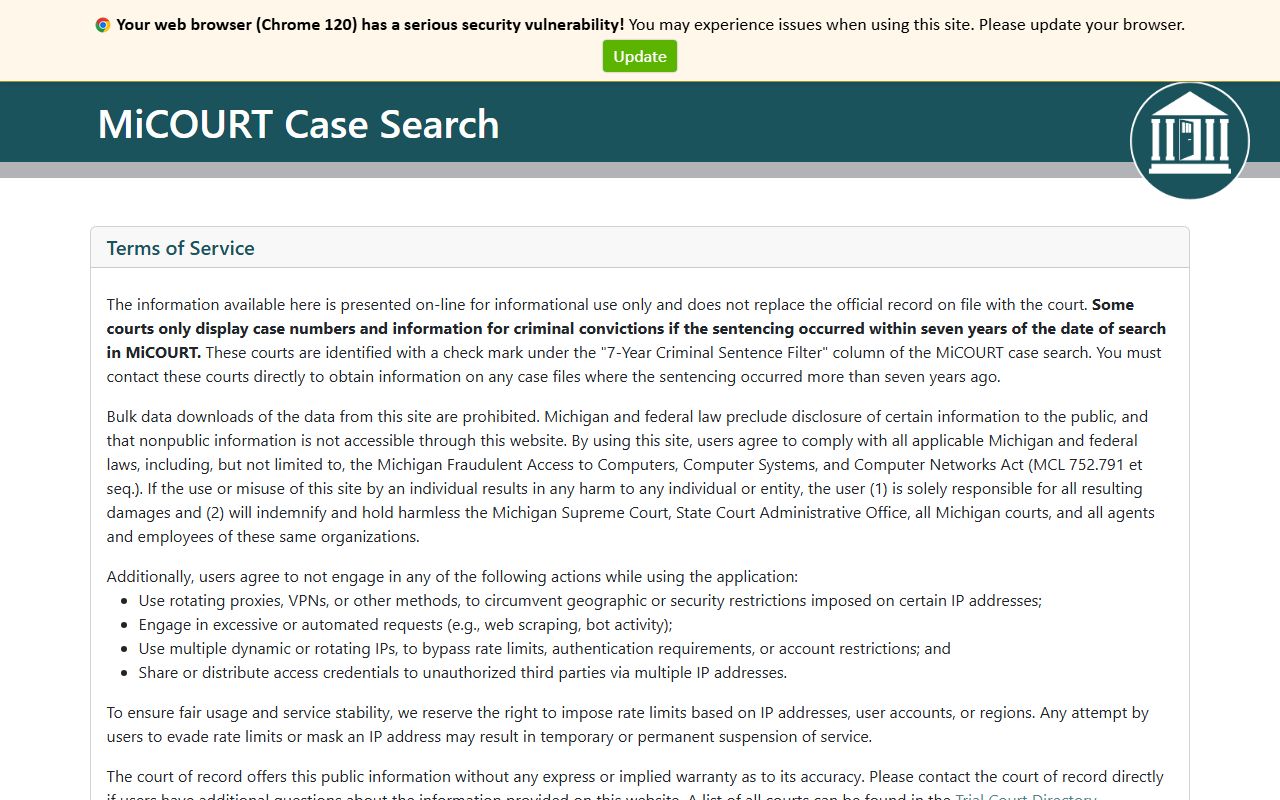
Use the portal for filed case information, then use the clerk when the public screen does not provide the needed document or status.
Lake County Arrest Charging Documents
After a Lake County jail arrest, the charging record begins with a formal court filing. The prosecutor's office is listed at 800 Tenth Street Suite 100 in Baldwin and is the local office that decides what charges to file from police reports and evidence. Jail booking charges can differ from the final charge list because the prosecutor may authorize some counts, decline others, or file a different level of offense.
| Document | Who Files It | What It Means |
|---|---|---|
| Complaint | Usually law enforcement and prosecutor review | Starts many criminal cases and states the accusation presented to court. |
| Information | Prosecutor | Often used in felony proceedings after the early court stage to state the charge for trial-level action. |
| Indictment | Grand jury process | Less common locally, but it is another formal charging route for serious matters. |
The District Court route matters for misdemeanors, arraignments, preliminary examinations, and early felony stages. The Circuit Court route matters for felony trial-level proceedings. Both are part of the public court-record path after an arrest, while the jail remains the source for current custody and booking status.
Lake County Charge Status Records
Charge status can change during a case. A person may be booked on one suspected offense, arraigned on another, and later face amended or reduced charges. A dismissal does not mean the arrest never occurred, and a pending charge is not a conviction. Court records after a Lake County arrest should be read by status and date, with attention to docket entries that show what the judge or prosecutor did most recently.
| Status | Plain Meaning | Why It Matters |
|---|---|---|
| Pending | The case or charge is still open. | Future hearings, bond conditions, and plea or trial dates may still apply. |
| Amended or reduced | The filed charge changed from the earlier version. | The court charge may no longer match the jail booking line. |
| Dismissed | The court ended that charge without a conviction on that count. | Other counts may still remain, so check the full case. |
| Nolle prosequi | The prosecutor declines to proceed on a charge. | Michigan records may still show the docket event unless restricted by law. |
| Disposed | The court entered an outcome. | The result may be plea, conviction, dismissal, sentence, or other order. |
Note: If the case status is unclear online, use the Trial Court clerk rather than guessing from a booking entry.
Lake County Arrest Bond Records
Bond in Lake County is usually set by a judge or magistrate at or after the first appearance, though some offenses may have interim practices. The official jail page does not publish a bond desk, bond schedule, payment vendor, accepted payment methods, or after-hours bond procedure. The research-backed route is to call the Lake County Jail before attempting payment, then call the Trial Court if jail staff direct bond questions to court.
| Bond Type | How It Works | Lake County Checkpoint |
|---|---|---|
| Cash bond | Full cash amount may be required. | Confirm payment forms and location before traveling. |
| Surety bond | A commercial bail agent may post if the order permits it. | Ask whether the bond order allows surety. |
| Personal recognizance | Release is based on a written promise and court conditions. | No cash is due unless conditions later create a sanction. |
| Ten-percent bond | Some Michigan orders allow a ten-percent deposit. | Verify the exact wording with the court or jail. |
| No-bond hold | Payment will not cause release. | Common causes include probation, parole, ICE, federal, or another-county holds. |
A person may appear bondable from the first booking information yet remain in custody because another hold exists. Ask the jail whether the hold is local, from another Michigan county, tied to MDOC, federal, or immigration-related. If the jail directs the caller to court, the Lake County Trial Court main line is the court route for bond records and hearing status.
Lake County Arrest Warrants
No official Lake County online active warrant list was located in the sheriff, corrections, trial court, district court, or directory pages inspected. Warrant questions should be routed by purpose. Call the Sheriff's Office for warrant-record routing, use the court for bench warrants tied to an existing case, and use MiCOURT to review public docket entries when a case number or party name is known. The E-911 directory line is for urgent law-enforcement contact, not casual record browsing.
Arrest warrants order law enforcement to take a person into custody. Bench warrants are issued by a judge, often after a failure to appear or violation of a court order. Search warrants are different because they authorize a search of a place, person, or item and are not a jail lookup tool. A fugitive, out-of-county, probation, parole, federal, or ICE warrant can also create a hold after a Lake County arrest.
Lake County Charges vs Convictions
Court records after an arrest often show both accusations and outcomes, so the terms must stay separate. A charge is an allegation filed in court. A conviction is a result after a plea, verdict, or qualifying adjudication. Treating a charge as a conviction can distort the record, especially while a Lake County case is pending or when some counts were dismissed.
| Point | Charge | Conviction |
|---|---|---|
| Stage | Accusation filed after arrest review. | Final court outcome after plea or finding. |
| Proof level | Based on charging standards and probable cause. | Requires a plea or proof beyond a reasonable doubt. |
| Record meaning | Shows what the prosecutor alleged. | Shows what the court resolved as guilt or accepted plea. |
| Search caution | May be amended, reduced, or dismissed. | May still be eligible for set-aside in some cases. |
Sealed Lake County Arrest Records
Michigan public access rules do not make every arrest or court record visible forever. Juvenile matters, sealed cases, suppressed records, active-investigation material, and some dismissed or set-aside records may be restricted. MCL 28.243 addresses arrest-card, biometric-data, final-disposition, ICHAT removal, and destruction or expungement issues in specified no-charge, dismissal, and not-guilty situations. MCL 780.621 is Michigan's set-aside statute for qualifying adult convictions.
| Record Term | Public Effect | Where to Check |
|---|---|---|
| Sealed | Hidden from ordinary public access, but not necessarily erased. | Ask the Trial Court clerk about access limits. |
| Set aside | Michigan's expungement process for eligible convictions. | Use court and MSP Clean Slate resources. |
| Dismissed arrest record correction | May affect ICHAT and biometric records in listed circumstances. | Review MCL 28.243 and MSP guidance. |
Lake County Background Checks
Public court lookup is not the same as a regulated employment, housing, credit, or insurance background check. MiCOURT, the Trial Court clerk, MSP ICHAT, MDOC OTIS, VINE, BOP, and ICE each serve different record systems. A Lake County court record may show a filed criminal case, while ICHAT may show statewide public criminal-history repository information and exclude warrants, federal cases, tribal cases, traffic records, juvenile records, local misdemeanors, and out-of-state records.
Important: Public lookup information is not a consumer report and must not be used for FCRA-covered screening decisions.
Restricted Lake County Court Records After Arrest
Michigan FOIA starts from a policy of public access to government records. MCL 15.231 states that people are entitled to full and complete information about government affairs and official acts, while MCL 15.235 governs written requests, response timing, extensions, denials, and alternate responses. Those statutes help with jail or sheriff records that are not posted online, but court files follow court access rules as well.
For Lake County court records after an arrest, use the source that owns the record. The jail or sheriff handles custody and booking records. The prosecutor handles charging decisions and may not release investigative material. The Trial Court clerk handles filed court records and copies. MSP handles ICHAT repository records. MDOC OTIS handles state corrections status, while ICE ODLS handles immigration detention at North Lake Processing Center.